Neurofibromatosis Type 2
Summary
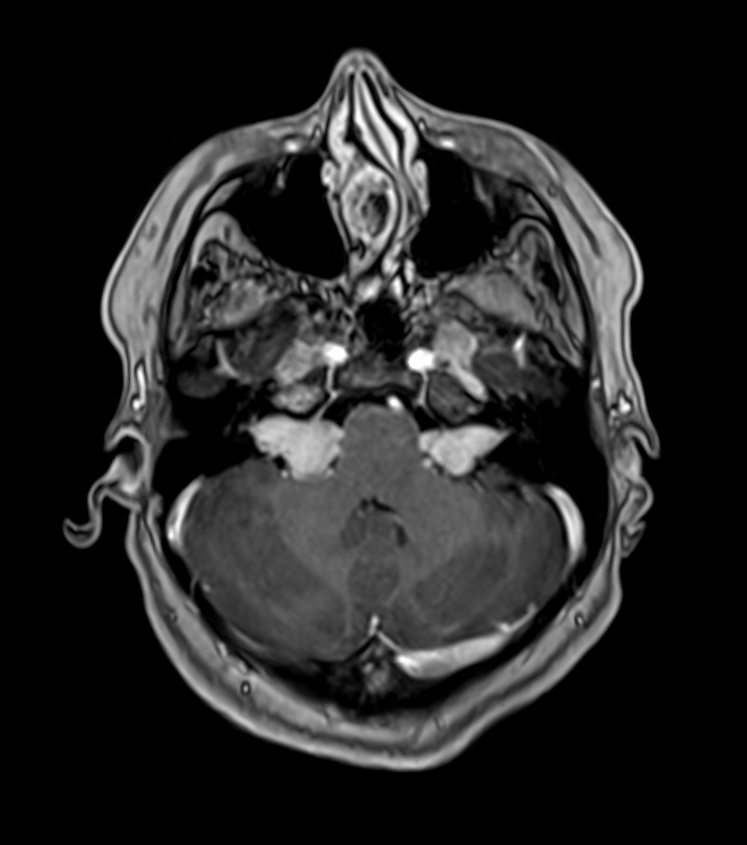
- Autosomal dominant tumour predisposition syndrome, also termed NF2-related schwannomatosis
- Caused by mutations in the NF2 gene, which encodes the tumour suppressor merlin (schwannomin)
- Hallmark is bilateral vestibular schwannomas, with multiple meningiomas, schwannomas and ependymomas
Pathophysiology
- Mutation in the NF2 gene on chromosome 22q12
- NF2 gene encodes merlin (schwannomin), a tumour suppressor protein
- Loss of merlin function leads to:
- Loss of contact-dependent growth inhibition
- Development of multiple nervous system tumours (schwannomas, meningiomas, ependymomas)
Demographics
- Incidence: approximately 1 in 25,000 to 33,000 live births
- No ethnic or gender predilection
- Roughly half of cases are inherited and half arise from de novo mutations
- Typically presents in the second or third decade
Diagnosis
- Clinical diagnosis based on the Manchester criteria, met by any of:
- Bilateral vestibular schwannomas
- First-degree relative with NF2 plus a unilateral vestibular schwannoma, or any two of: meningioma, schwannoma, glioma, neurofibroma, posterior subcapsular lenticular opacity
- Unilateral vestibular schwannoma plus any two of the above features
- Multiple meningiomas plus a unilateral vestibular schwannoma or any two of the above features
- Genetic testing for NF2 gene mutations1
Imaging
- MRI with contrast is the modality of choice:
- Bilateral vestibular schwannomas — enhancing cerebellopontine angle and internal auditory canal masses
- Multiple meningiomas, both intracranial and spinal
- Non-vestibular cranial nerve schwannomas
- Spinal cord ependymomas and schwannomas
- CT:
- Widening of the internal auditory canals
- Calcified meningiomas
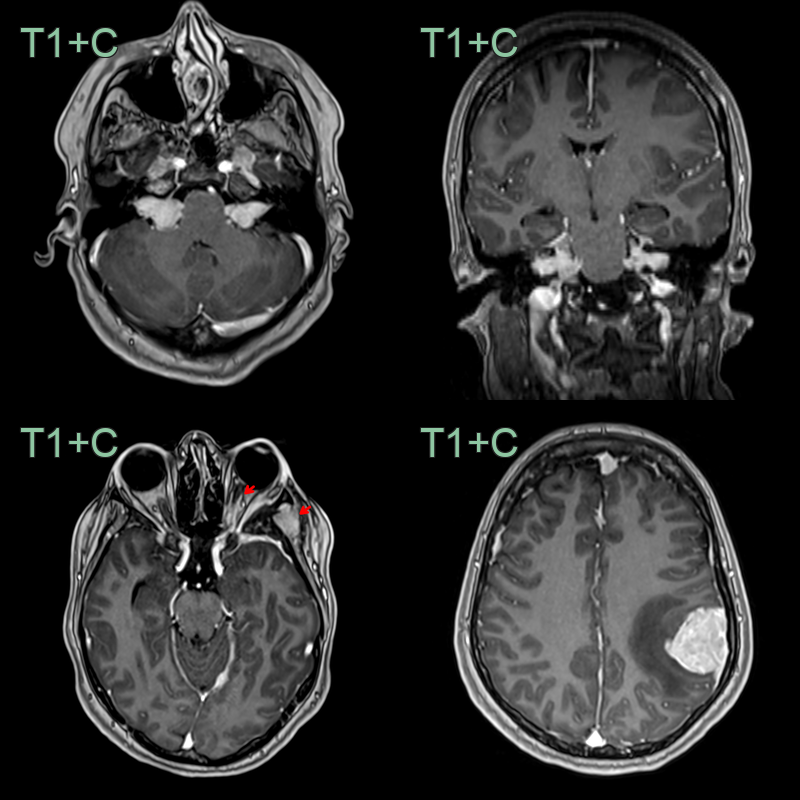
- A 20-year-old patient presented after a seizure.
- MRI showed bilateral vestibular schwannomas and many meningiomas (optic nerve sheath [red arrow], anterior falx and left parietal region).
Treatment
- Surveillance MRI for tumour development and growth
- Surgical resection or stereotactic radiosurgery for vestibular schwannomas
- Bevacizumab (anti-VEGF) can reduce vestibular schwannoma volume and improve hearing in selected patients
- Hearing preservation and rehabilitation, including auditory brainstem implants
Differential diagnosis
| Differential Diagnosis | Distinguishing Feature |
|---|---|
| Neurofibromatosis type 1 | Café-au-lait macules, cutaneous and plexiform neurofibromas, optic pathway gliomas; caused by the NF1 gene |
| Schwannomatosis (SMARCB1/LZTR1) | Multiple non-vestibular schwannomas without bilateral vestibular schwannomas |
| Sporadic vestibular schwannoma | Unilateral, no other syndromic tumours or family history |
| Meningiomatosis | Multiple meningiomas without vestibular schwannomas or an NF2 mutation |
| Solitary meningioma | Single dural-based mass without associated schwannomas |
-
Asthagiri et al. Neurofibromatosis type 2. 2009. Lancet (London, England) - Open in new tab. ↩