CARASAL
Summary
- Cathepsin A-Related Arteriopathy with Strokes And Leukoencephalopathy: a hereditary cerebral small vessel disease
- Autosomal dominant, caused by mutations in CTSA (cathepsin A)
- MRI shows a diffuse confluent leukoencephalopathy with characteristic brainstem and internal capsule involvement and lacunar infarcts
Pathophysiology
- Autosomal dominant mutation in CTSA (chromosome 20)
- Cathepsin A dysfunction disturbs vasoregulation (endothelin-1 and bradykinin handling), producing a non-amyloid small vessel arteriopathy
- Chronic white matter ischaemia and lacunar infarction result
Demographics
- Very rare; originally described in a large Dutch pedigree
- Adult onset, typically from middle age
Diagnosis
- Clinical features: treatment-resistant hypertension, ischaemic stroke, cognitive decline, migraine and prominent muscle cramps
- Confirmed by CTSA genetic testing
Imaging
- MRI:
- Diffuse, confluent T2/FLAIR leukoencephalopathy of the cerebral white matter and internal/external capsules
- Characteristic brainstem (pons) and superior cerebellar peduncle involvement
- Lacunar infarcts
- Relatively few microhaemorrhages, unlike CADASIL or amyloid angiopathy1
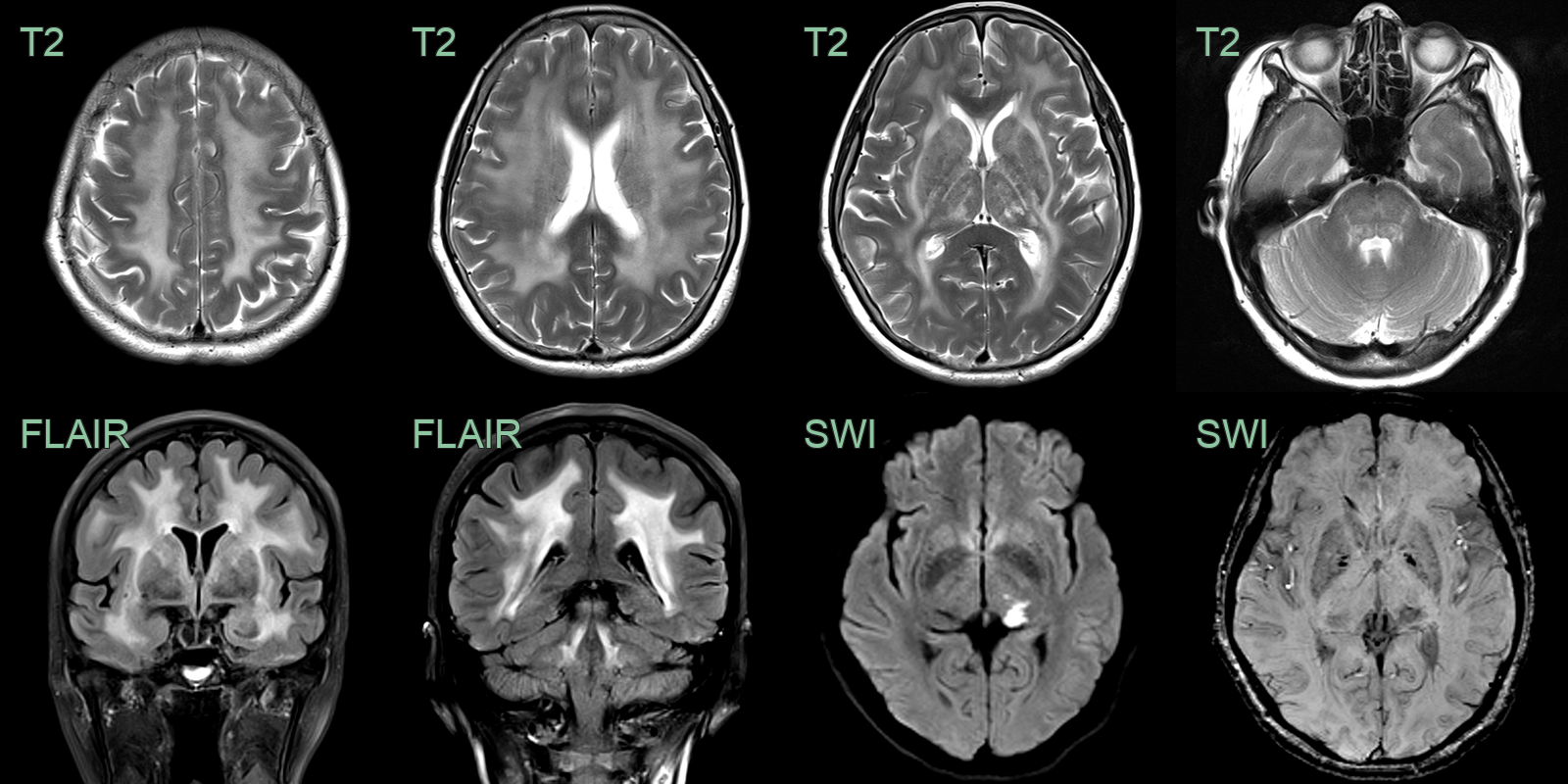
- A 50-year-old patient presented with a homonymous hemianopia and motor and sensory disturbance.
- MRI showed an acute left thalamic infarct on a background of a diffuse leukoencephalopathy affecting the cerebral and capsular white matter, the brainstem and superior cerebellar peduncles.
- There were no microhaemorrhages.
Treatment
- Supportive; vascular risk-factor and blood-pressure management
Differential diagnosis
| Imaging differential | Differentiating feature |
|---|---|
| CADASIL | Anterior temporal pole and external capsule white matter hyperintensities; NOTCH3 mutation |
| CARASIL | Similar confluent white matter pattern; autosomal recessive HTRA1 mutation; early-onset spondylosis and alopecia |
| Hypertensive microangiopathy | Deep white matter and basal ganglia hyperintensities; spares the anterior temporal poles |
| COL4A1-related small vessel disease | Deep cerebral microhaemorrhages; lacunar infarcts; porencephaly; COL4A1/COL4A2 mutations |
| MELAS | Stroke-like lesions not conforming to vascular territories; elevated serum/CSF lactate |
| Cerebral amyloid angiopathy | Lobar microhaemorrhages; posterior predominance; cortical superficial siderosis |
| CSF1R-related leukoencephalopathy | Confluent white matter disease with calcifications on CT; thalamic involvement |
| Susac syndrome | Corpus callosum "snowball" lesions at the central fibres; hearing loss; branch retinal artery occlusions |
-
Bugiani et al. Cathepsin A-related arteriopathy with strokes and leukoencephalopathy (CARASAL). 2016. Neurology - Open in new tab. ↩